
Canonical JSON
Machine-readable profile contracts with build metadata, support summaries, confidence, and compatibility warnings.
 Imprint
Evidence. Expression. Identity.
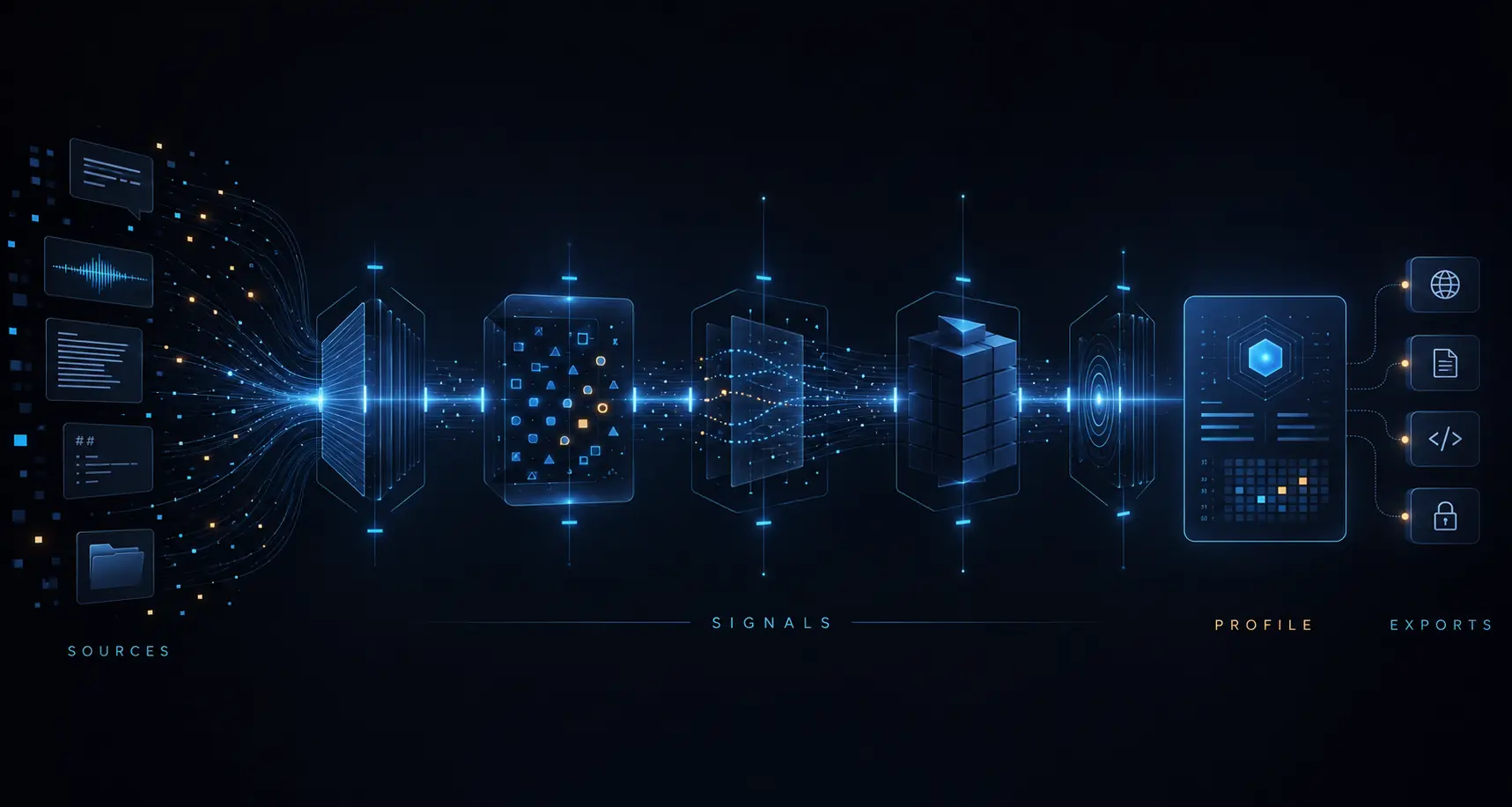
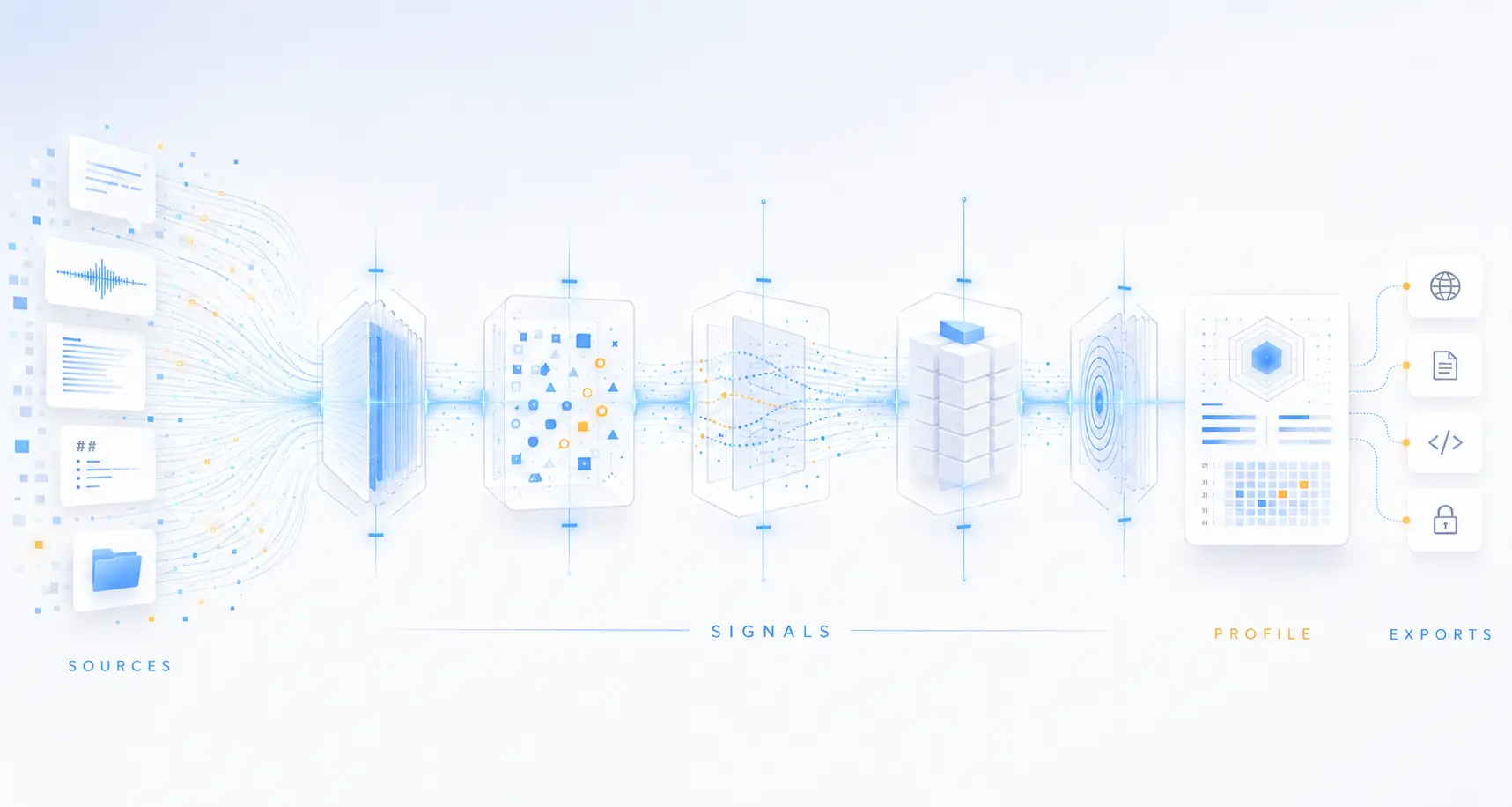
Imprint analyzes human-authored artifacts — writing, messages, transcripts, notes, and documents — then compiles structured expression profiles that downstream systems can use without reading the raw private corpus.
Open-source · Local-first · MIT License
What it is
Imprint is an independent expression compiler. It turns human-created artifacts into versioned, evidence-backed expression profiles that downstream systems can consume without direct corpus access.
Exports
Compiled profiles export as deterministic JSON, human-readable Markdown, first-run "What Imprint Learned" summaries, Mosvera expression overlays, and consumer-safe projections — all with compatibility warnings and no raw text, provider prompts, or private locators.
Machine-readable profile contracts with build metadata, support summaries, confidence, and compatibility warnings.
Concise observed-pattern reports that explain what the profile is based on without overstating certainty.
"What Imprint Learned" turns compiled profile data into a useful first experience, not a personality assessment.
A bridge contract for expression summaries and avoid-patterns, while Mosvera keeps aesthetic intent separate.
What it is not
Imprint observes expression patterns supported by evidence. It does not diagnose people, infer mental health states, or simulate a person.
Profile theory: Imprint may describe observable expression patterns — "frequently uses operational evidence before generalization" — but never generates diagnoses, personality claims, or intent inferences.
Why it matters
People increasingly use AI to draft, publish, and represent them — but the reusable contract for a person's expression is weak. Raw few-shot prompts leak private samples, age poorly, and cannot explain confidence. Memory systems store facts but do not separate expression, provenance, and contamination.
Imprint exists to produce a durable, auditable profile contract that downstream tools can apply without owning your raw corpus.
Optimize for immediate draft generation. Imprint produces the durable profile contract those tools can consume.
Store facts and preferences for agents. Imprint compiles expression signals — it does not compete as a memory store.
Simulate conversation and delegation. Imprint stays bounded to evidence-backed expression, not persona simulation.
Enforce approved language in enterprise workflows. Imprint exports portable profiles; downstream adapters own generation.
Current status
Imprint is no longer just a project thesis. The repository now contains the full evidence pipeline: ingestion, classification, signal extraction, profile compilation, public-safe exports, consumer contracts, and a private connector framework.
Adapters, connectors, classifiers, signal extractors, compiler, exporters, and consumer projections are implemented and tested.
Opaque source IDs, no-raw-text public exports, evidence-backed claims, version metadata, and compatibility warnings are built in.
Each major layer has been reviewed adversarially for privacy, scope creep, versioning, and boundary failures.
Public web polish, future private-source adapters, profile comparison, and downstream integrations built on existing contracts.
Integration surfaces
Imprint exports canonical profile contracts. Other systems consume projections of those contracts without owning profile inference, raw corpus access, prompt assembly, or runtime behavior.
Consumes expression overlays. Imprint compiles expression; Mosvera compiles aesthetic intent.
Consumes publishing constraints and expression summaries, not prompts, workflows, schedules, or generation settings.
Consume safe profile projections, evidence summaries, limitations, and compatibility warnings.
Generic connectors support future private adapters while keeping real credentials, corpora, and source paths out of the public repo.
Privacy
This repository is designed to be public from the beginning. Real corpora, secrets, local configs, and private exports stay out of git.
Default local mode runs without cloud providers, private connectors, or network calls. Synthetic examples power public demos.
Bring your own model and provider. Remote inference is optional, visible when used, and never required for basic operation.
Public-safe exports contain no raw private text. Richer metadata and excerpts exist only in ignored local paths you control.
Public-safe mode rejects raw examples. Provider secrets, private URLs, and account identifiers never belong in canonical schemas.